

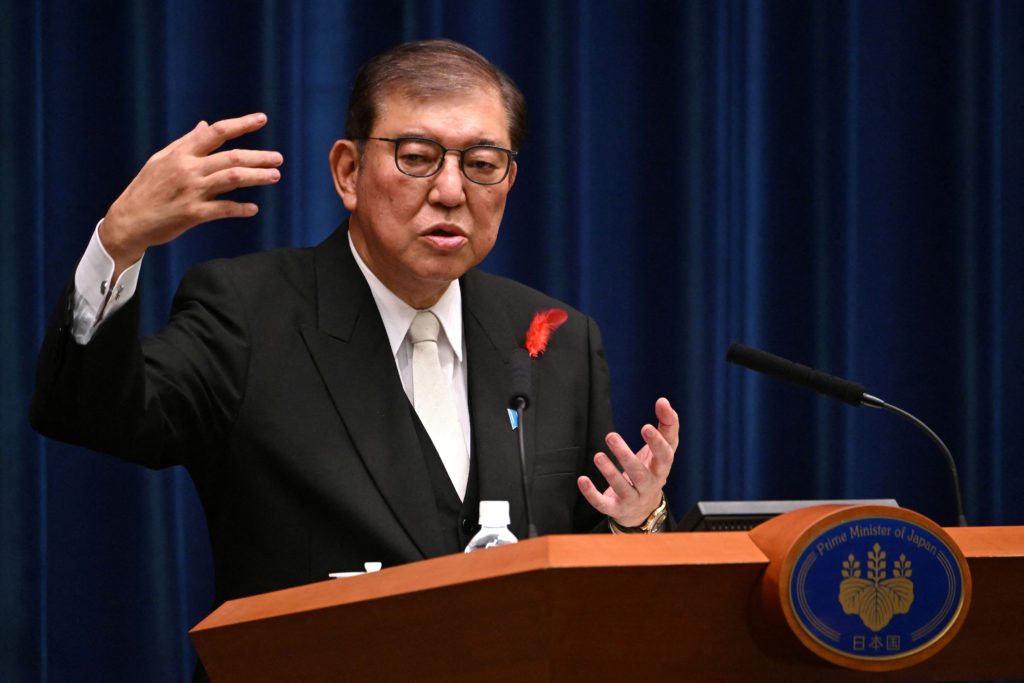
For the first time, U.S. President Donald Trump and Japanese Prime Minister Shigeru Ishiba will sit down face to face on Friday.
Both leaders see China’s rise as a challenge and want to deepen economic and security ties, but their meeting comes as an intensifying trade war looms over global markets.
Trump has spent his first weeks in office rattling foreign capitals from Ottawa to Bogotá, breaking norms at home and abroad. Yet when it comes to Washington’s key Asia-Pacific allies—Japan, South Korea, Australia, and the Philippines—he has taken a more traditional approach.
In what he called an “opening salvo,” Trump slapped a 10% tariff on all Chinese imports. The move sent businesses and consumers scrambling as the world’s two largest economies head toward a standoff.
Japan, heavily dependent on trade, is watching closely. The country exports heavily, relies on imports for key resources like food and energy, and has deep economic ties to China—both as a market and as a manufacturing hub.
Tokyo is aligned with Trump’s national security team in viewing China’s growing influence as a threat. That includes Beijing’s broad territorial claims across Asia, particularly over Taiwan, the chip-producing island at the heart of U.S.-China tensions.
Still, Japan remains wary. Officials in Tokyo see the possibility of Beijing trying to win Trump over with offers of cooperation, particularly on trade. Days before taking office, Trump spoke with Chinese President Xi Jinping and has since said he plans to discuss tariffs with him soon.
Behind the scenes, Japanese officials are comfortable working with Trump’s China hawks—figures like Secretary of State Marco Rubio and National Security Adviser Michael Waltz.
But they are less sure about others in his administration with business ties to Beijing. That includes billionaire Elon Musk, who has built a powerful influence network in Washington.
Trump and Ishiba are set to hold a joint press conference Friday afternoon.
Japan Prepares for Trump’s Demands
For Tokyo, the early White House meeting is a promising signal from the new administration.
“Only two foreign leaders have been received in the Oval Office so far,” said Rahm Emanuel, Biden’s ambassador to Tokyo. “That’s Bibi Netanyahu of Israel and Japan. So that’s a good thing, and that’s a good sign.”
Trump had a strong relationship with Japan’s late Prime Minister Shinzo Abe but has no prior ties to Ishiba, who took office in October. Japanese officials want to change that—and they’re already planning to invite Trump to Japan.
But they also expect pressure. Trump is likely to push for trade concessions, looking to shrink Japan’s $56 billion trade surplus with the U.S. and avoid the threat of tariffs.
Tokyo has been preparing its response. Officials say potential concessions include support for a $44 billion gas pipeline in Alaska. SoftBank CEO Masayoshi Son has also pledged billions in artificial intelligence investments in the U.S.
Other possibilities on the table include increased manufacturing investment in the U.S. and deeper cooperation on semiconductor production.
“The Japanese are looking at ways to cut the deficit while creating U.S. jobs in industries Trump cares about,” said Kenneth Weinstein, head of the Japan program at Washington’s Hudson Institute.
Trade isn’t the only issue. Japan’s Nippon Steel is attempting to acquire U.S. Steel, a deal Biden blocked but left in legal limbo. Trump has vowed to kill the takeover outright.
Still, signs of continuity remain. The two leaders are expected to issue a joint statement reaffirming their alliance and shared priorities—chief among them, economic security and countering China.
But any goodwill could be short-lived. Trump has already signaled an early clash with China over synthetic opioids and hinted at broader tariffs, including on Japan. The risk of fresh disruptions to global trade is only growing.